
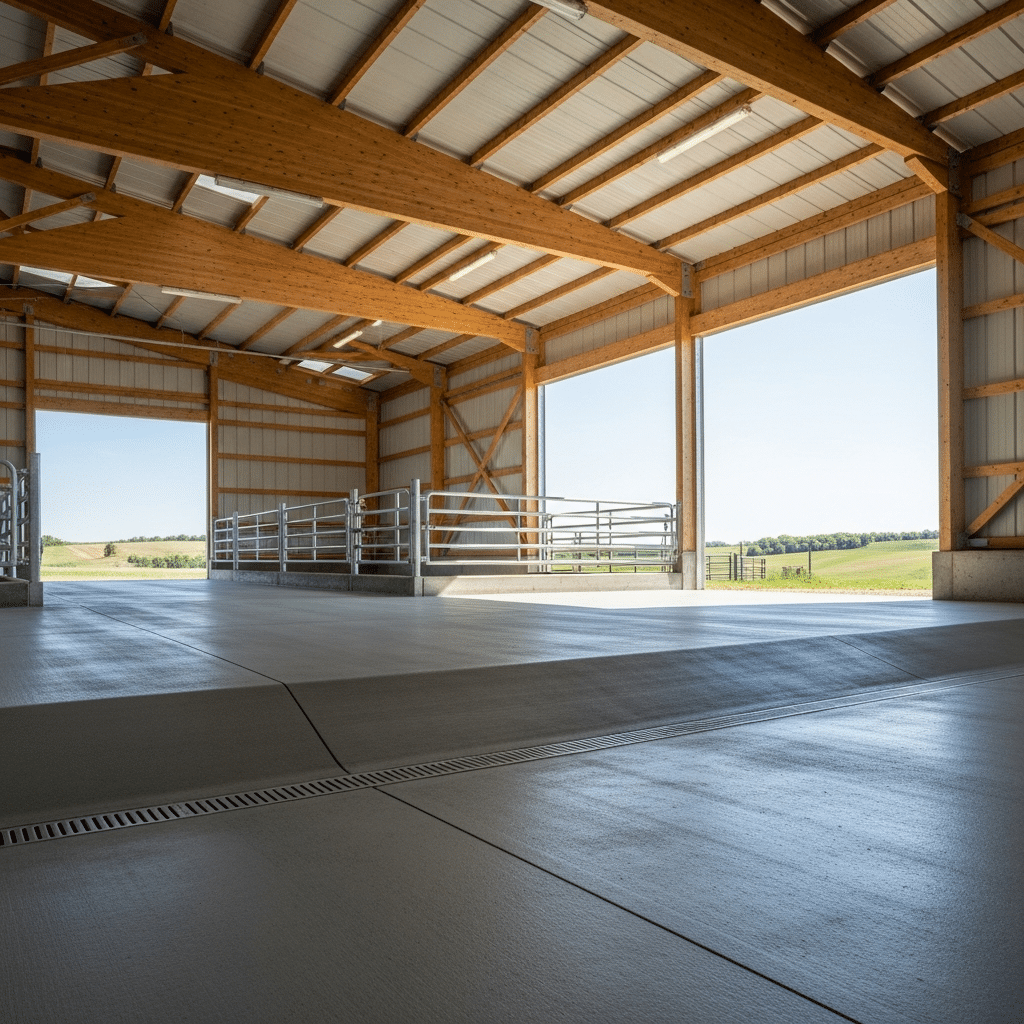
Last Updated: February 25, 2026
Are you planning to upgrade your barn flooring in Lawrence, KS, but unsure whether concrete is the right choice? For agricultural operations across Douglas County, concrete barn floors represent a critical investment that impacts daily operations, animal welfare, equipment maintenance, and long-term facility value. Whether you’re converting a historic stone barn or constructing a new agricultural building, the flooring decision affects everything from drainage and sanitation to structural durability.
Lawrence’s agricultural heritage includes historic structures like the Grover Barn (built 1858) and the Taylor Barn (built 1879), which originally featured stone and timber construction. As modern agricultural demands evolve, many property owners are retrofitting these structures or building new facilities with concrete barn floors Lawrence KS agricultural professionals design for longevity, ease of maintenance, and operational efficiency. The transition from traditional materials to concrete reflects broader trends in farm modernization across Kansas.
Quick Answer: Why Choose Concrete Barn Floors?
Concrete barn floors provide superior durability, sanitation, and maintenance efficiency for agricultural operations in Lawrence, KS. According to Cornell Law School, They withstand heavy equipment loads, resist moisture damage from Kansas freeze-thaw cycles, and offer easier cleaning than dirt, wood, or stone alternatives. Properly installed concrete floors last 30+ years with minimal maintenance.
Key Benefits of Concrete Barn Floors:
- Durability: Resists cracking from heavy tractors, livestock traffic, and equipment storage
- Sanitation: Non-porous surface prevents bacteria growth and simplifies cleaning protocols
- Cost-Effectiveness: Lower long-term maintenance costs compared to wood or gravel alternatives
- Weather Resistance: Withstands Kansas temperature extremes and moisture fluctuations
- Versatility: Suitable for livestock housing, equipment storage, hay barns, and multi-purpose agricultural spaces
Understanding Agricultural Concrete Requirements in Lawrence, KS
When our team works throughout Lawrence, KS—from zip codes 66044 and 66046 to rural areas in 66049—we consistently encounter agricultural properties requiring specialized concrete solutions. The demands placed on concrete barn floors Lawrence KS agricultural operations use differ significantly from residential or commercial applications. Agricultural concrete must accommodate heavier loads, resist chemical exposure from animal waste and fertilizers, and provide proper drainage for sanitation.
Load-Bearing Capacity for Farm Equipment
Modern agricultural equipment places extreme demands on barn flooring. A typical tractor can weigh 8,000-15,000 pounds, while loaded hay wagons or combine harvesters exceed 20,000 pounds. Standard residential concrete (3,000 PSI) proves insufficient for these loads. Agricultural barn floors typically require 4,000-5,000 PSI concrete with reinforced steel mesh or rebar to prevent cracking under point loads from equipment wheels and hydraulic jacks.
The substrate preparation proves equally critical. We excavate to proper depth, ensuring compacted aggregate base layers of 4-6 inches that distribute weight evenly. This prevents differential settling that causes cracks—a common problem we observe in older barn conversions where concrete was poured directly over native soil without proper base preparation.
Climate Considerations: Kansas Freeze-Thaw Cycles
Lawrence experiences significant temperature fluctuations, with winter lows reaching single digits and summer highs exceeding 95°F. This thermal stress challenges concrete integrity. Due to Kansas freeze-thaw cycles, we always specify air-entrained concrete—a contrarian approach many national contractors overlook. Air-entrained concrete contains microscopic air bubbles that provide expansion space when moisture freezes, preventing the surface spalling and cracking that destroys non-treated concrete within 5-10 years.
According to the Portland Cement Association, air entrainment increases freeze-thaw resistance by up to 400% in regions experiencing more than 25 freeze-thaw cycles annually—a threshold Lawrence regularly exceeds. This local climate adaptation distinguishes experienced regional contractors from generic national providers.
Drainage and Slope Engineering
Proper drainage separates functional agricultural floors from problematic installations. For livestock barns, we engineer slopes of 1-2% toward drainage channels or troughs, allowing liquids to flow away from animal housing areas. Equipment storage barns require gentler slopes (0.5-1%) to prevent pooling while maintaining level parking areas. This precision demands laser-level surveying and skilled finishing—rushing the process creates low spots where water accumulates, accelerating concrete deterioration and creating unsanitary conditions.
Common Mistakes When Installing Barn Concrete Floors
We’ve restored dozens of failed barn floor installations across Douglas County. Understanding these common errors helps property owners avoid costly replacements and ensures their initial investment delivers decades of service.
Insufficient Thickness and Reinforcement
The most frequent mistake involves pouring concrete too thin or omitting reinforcement. Residential slabs typically use 4-inch thickness, but agricultural applications demand 6-8 inches depending on anticipated loads. A hay storage barn might function adequately with 6 inches and wire mesh, while a working barn housing heavy equipment requires 8 inches with #4 rebar grid spacing at 18-24 inches.
Property owners attempting DIY installations often underestimate these requirements, creating floors that crack within the first year under normal use. Professional concrete slab installation accounts for specific load calculations and usage patterns.
Poor Vapor Barrier Installation
Moisture migration from underlying soil causes numerous problems: surface dusting, reduced strength, and accelerated deterioration. A 6-mil polyethylene vapor barrier placed between the aggregate base and concrete prevents this moisture transfer. However, improper installation—tears, insufficient overlap, or gaps around penetrations—compromises effectiveness. We overlap barrier seams by 12 inches minimum and tape all joints, creating a continuous moisture barrier.
Rushing the Curing Process
Concrete achieves 70% of its design strength in seven days but requires 28 days for full curing. Farmers eager to resume barn operations often load new floors prematurely, causing micro-cracking that compounds over time. We recommend applying curing compounds immediately after finishing and restricting heavy loads for at least 14 days, with full load capacity delayed until 28 days. This patience prevents problems that otherwise manifest within the first year.
Best Practices for Agricultural Concrete Floors
Successful barn floor installations follow proven methodologies that account for Lawrence’s specific conditions and agricultural demands. Our experience across hundreds of agricultural projects informs these recommendations.
Site Preparation and Excavation
Before any concrete work begins, coordinate with Evergy and Kansas Gas Service to locate underground utilities. Agricultural properties often have buried electrical lines to outbuildings, irrigation systems, and gas connections that aren’t always well-documented. Excavation depth depends on existing grade, but typically we remove 12-14 inches to accommodate the aggregate base (6 inches), vapor barrier, and concrete thickness (6-8 inches).
Soil testing determines bearing capacity. Douglas County soils vary significantly—some areas feature stable clay, while others contain expansive soils requiring additional stabilization. Professional concrete floor installation begins with proper site evaluation.
Concrete Mix Design for Agricultural Applications
Specifying the appropriate concrete mix proves crucial for long-term performance. For concrete barn floors Lawrence KS agricultural professionals install, we recommend:
| Application Type | Minimum PSI | Special Requirements |
|---|---|---|
| Equipment Storage/Workshop | 4,000-5,000 PSI | Air-entrained, fiber reinforcement optional |
| Dairy/Livestock Housing | 4,000 PSI | Air-entrained, textured finish for traction |
| Hay/Grain Storage | 3,500-4,000 PSI | Air-entrained, smooth finish |
| Heavy Equipment Maintenance | 5,000+ PSI | Air-entrained, steel fiber reinforcement |
Air entrainment remains non-negotiable for all exterior-exposed applications and recommended for enclosed barns experiencing temperature swings. The slight reduction in compressive strength (typically 5-8%) is vastly outweighed by dramatically improved freeze-thaw durability.
Surface Finishing Techniques
Surface finish impacts both functionality and safety. Livestock barns require textured finishes providing traction for animal movement—a smooth troweled finish proves dangerously slippery when wet. We achieve appropriate texture through broom finishing or using textured rollers after initial bull floating. Equipment storage barns benefit from smoother finishes that facilitate cleaning and resist abrasion from metal implements.
For specialized applications like polished concrete in agricultural event spaces or renovated barns, the finishing process becomes more complex, requiring diamond grinding and densification.
Step-by-Step Installation Process for Barn Concrete Floors
Understanding the installation sequence helps property owners prepare for the project timeline and coordinate farm operations around construction activities.
Phase 1: Preparation and Layout (Days 1-2)
The project begins with thorough site assessment and utility location. We establish elevation benchmarks using laser levels to ensure proper drainage slopes. Existing flooring materials (dirt, gravel, or deteriorated concrete) are removed and hauled away. For retrofits in historic structures like those near Stone Barn Terrace or along the Kaw River bottoms, we assess existing foundation integrity and address any structural concerns before proceeding.
Phase 2: Base Installation and Compaction (Days 3-4)
Crushed limestone aggregate (3/4-inch minus) provides optimal base material for agricultural floors. We install it in 2-3 inch lifts, compacting each layer with plate compactors or vibratory rollers to achieve 95% density. This multi-lift approach prevents future settling that causes concrete cracking. The finished base surface is laser-graded to match the designed drainage slopes.
After base compaction, we install the 6-mil polyethylene vapor barrier with careful attention to overlaps and penetrations. Edge forms are set using dimensional lumber or steel forms, secured with stakes to resist concrete pressure during the pour.
Phase 3: Reinforcement and Pour (Day 5)
Reinforcement placement occurs morning of the pour. Wire mesh sits on plastic or metal chairs maintaining proper height (typically mid-slab), while rebar is tied in grids per engineering specifications. Control joints are planned every 10-15 feet to manage shrinkage cracking—these joints create intentional weak points where cracks occur in controlled locations rather than randomly across the floor.
Concrete delivery is scheduled for optimal conditions—avoiding extreme temperatures and high winds. Ready-mix trucks deliver specified mix designs in sequence, with crews immediately spreading and bull floating the concrete. Laser screeds or traditional screeding establishes precise elevations matching designed slopes. For larger barns, we may pour in sections to maintain quality control throughout the process.
Phase 4: Finishing and Curing (Days 6-33)
After screeding, power troweling or broom finishing creates the desired surface texture. Control joints are cut within 6-12 hours using early-entry saws before random cracking occurs. Curing compound is applied immediately to retain moisture and prevent premature drying that weakens the concrete surface.
The critical 28-day curing period begins. Light foot traffic is acceptable after 7 days, but heavy equipment should remain off the floor until at least 14 days, with full load capacity delayed until 28 days for optimal long-term performance.
Cost Considerations for Agricultural Concrete Floors
Budgeting accurately for barn floor installation requires understanding the factors driving costs. In Lawrence, KS, agricultural concrete projects typically range from $6.50-$12.00 per square foot installed, depending on specifications and site conditions. This compares favorably to residential rates since agricultural projects often involve larger square footage with economies of scale.
A 3,000 square foot equipment barn might cost $19,500-$30,000 for a complete 6-inch slab with standard reinforcement. Upgrading to 8-inch thickness with heavy rebar adds approximately $1.50-$2.50 per square foot. For detailed pricing specific to your project scope, understanding concrete slab cost per square foot variables proves essential.
Cost factors include:
- Site accessibility: Remote rural locations requiring long concrete truck travel or difficult access increase costs
- Excavation requirements: Removing existing materials or addressing poor soils adds $1-3 per square foot
- Concrete specifications: Higher PSI mixes, fiber reinforcement, and special additives increase material costs 15-25%
- Drainage infrastructure: Installing floor drains, trenches, or French drains adds $500-2,000 depending on complexity
- Seasonal timing: Winter pours requiring heated enclosures or special admixtures cost 20-40% more than spring/fall installations
Commercial vs. Agricultural Concrete Applications
While agricultural barn floors share similarities with commercial concrete installations, important distinctions exist in design priorities and performance requirements. Understanding these differences helps property owners communicate effectively with contractors and ensure specifications match intended use.
Commercial concrete prioritizes aesthetic finish, foot traffic durability, and compliance with ADA accessibility standards. Agricultural applications emphasize heavy load capacity, chemical resistance, and functional drainage over appearance. A retail space might use decorative stamped concrete with sealers to achieve specific aesthetics, while a working barn requires utilitarian design optimized for cleaning, drainage, and equipment movement.
The regulatory environment also differs. Commercial projects must meet strict building codes regarding fire ratings, accessibility, and structural engineering certification. Agricultural buildings often fall under different regulatory frameworks—though property owners should verify local requirements with Douglas County planning departments before assuming exemptions apply.
Frequently Asked Questions About Barn Concrete Floors
How long do concrete barn floors typically last?
Properly installed agricultural concrete floors regularly exceed 30-40 years of service life with minimal maintenance. The longevity depends on installation quality, concrete specifications, and usage intensity. Floors experiencing daily heavy equipment traffic may show surface wear after 20-25 years but remain structurally sound. Applying penetrating sealers every 5-7 years extends surface durability significantly.
Can concrete floors be installed in existing historic barns?
Yes, concrete floors can be retrofitted into existing structures, though the process requires careful evaluation of foundation capacity and drainage planning. Historic barns like the Grover Barn or Taylor Barn were built on stone foundations that may require reinforcement before supporting modern concrete floor loads. We assess existing foundation integrity and recommend any necessary structural upgrades before proceeding with floor installation.
What maintenance do concrete barn floors require?
Agricultural concrete requires minimal maintenance compared to alternatives. Regular sweeping removes debris that can cause abrasion. Periodic pressure washing addresses accumulated dirt and organic matter. Every 5-7 years, apply penetrating silicate or silicone sealers that protect against moisture intrusion and chemical exposure. Address any developing cracks promptly with epoxy or polyurethane crack fillers to prevent expansion. This modest maintenance schedule preserves floor integrity for decades.
Are concrete floors suitable for all types of livestock?
Concrete floors work well for most agricultural applications but require appropriate surface treatments for livestock comfort. Dairy cows, horses, and other large animals benefit from textured finishes providing traction. Rubber mats can be added in stall areas where animals stand for extended periods, combining concrete’s sanitation benefits with cushioned standing surfaces. The key is balancing concrete’s durability and cleanability with animal welfare considerations through proper finishing and supplemental materials.
How does Lawrence’s climate affect barn floor installations?
Lawrence’s temperature extremes and freeze-thaw cycles significantly impact concrete performance. Air-entrained concrete proves essential for exterior-exposed applications and recommended for all agricultural floors. We avoid pouring during temperature extremes—summer heat above 90°F or winter cold below 40°F requires special procedures that increase costs. Spring and fall provide optimal conditions for agricultural concrete projects, allowing proper curing without temperature-related complications.
Conclusion: Investing in Durable Agricultural Infrastructure
Quality concrete barn floors represent a long-term infrastructure investment that enhances operational efficiency, property value, and facility functionality for decades. In Lawrence, KS, where agricultural heritage meets modern farming demands, choosing experienced contractors who understand both local conditions and agricultural requirements proves essential for successful outcomes.
From historic barn retrofits near Massachusetts Street to new agricultural facilities in rural Douglas County, proper planning, specification, and execution separate functional floors lasting 30+ years from problematic installations requiring premature replacement. The investment in quality materials, proper reinforcement, and skilled installation pays dividends through reduced maintenance costs, improved sanitation, and enhanced facility value.
Whether you’re planning a new barn construction, converting existing structures for modern use, or upgrading deteriorated flooring in established agricultural facilities, working with experienced professionals ensures your concrete floors meet the demanding requirements of Kansas agricultural operations. Local options for agricultural concrete services include Lawrence Concrete Pros and other established regional providers familiar with Douglas County soil conditions, climate challenges, and agricultural applications.
For property owners throughout Lawrence—from the University of Kansas agricultural research areas to working farms in zip codes 66044, 66046, and 66049—concrete barn floors deliver the durability, sanitation, and longevity modern agricultural operations demand.
Sources and References
- Portland Cement Association – www.cement.org – Air-entrained concrete specifications and freeze-thaw resistance data
- Kansas Historical Society – Historic agricultural structures documentation
- Douglas County Planning and Building Safety – Local building codes and agricultural exemptions
- American Concrete Institute – Agricultural concrete design guidelines